What Are the 5 C’s of Security Guards?
Security guards play an important role in protecting people, property, businesses, and communities across the United States. Their responsibilities can range from monitoring access points and conducting patrols to documenting incidents, responding to emergencies, and communicating with clients, employees, visitors, and law enforcement.
But effective security work involves more than simply being present. A professional security guard needs the right combination of personal character, job knowledge, communication skills, sound judgment, and commitment to the assignment.
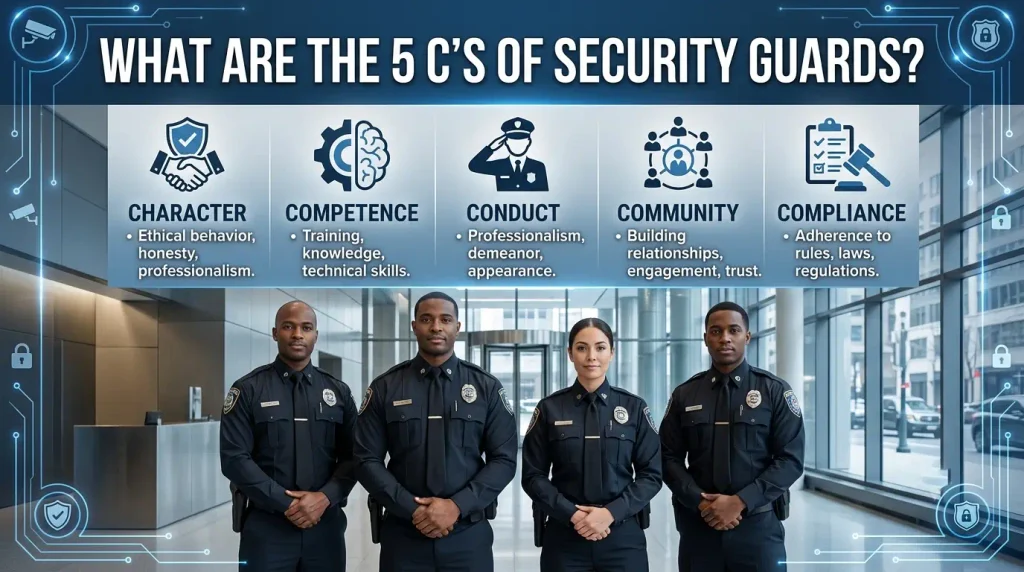
These qualities are often explained through the 5 C’s of security guards: Character, Competence, Communication, Critical Thinking, and Commitment. Together, these five qualities provide a practical framework for understanding what makes a security professional effective and dependable.
Important: The 5 C’s are a professional framework, not a single federally mandated standard for all security guards in the United States. Security guard licensing and training requirements vary by state. For example, California regulates security guards through the Bureau of Security and Investigative Services (BSIS), with requirements covering registration, background checks, training, use of force, legal responsibilities, and continuing education.
Quick Answer: What Are the 5 C’s of Security Guards?
The five C’s are:
- Character – Acting honestly, responsibly, and ethically.
- Competence – Having the training, knowledge, and skills required for the assignment.
- Communication – Clearly communicating with clients, employees, visitors, supervisors, and emergency responders.
- Critical Thinking – Assessing situations and making reasonable decisions based on available information.
- Commitment – Remaining attentive, professional, and dependable throughout the assignment.
These qualities work together. A guard may have strong technical skills, for example, but effective security also requires professional conduct, communication, judgment, and consistency.
1. Character: The Foundation of Professional Security Work
Character is one of the most important qualities for anyone working in private security. Security guards are often trusted with access to private property, sensitive information, restricted areas, employees, customers, and valuable assets.
Professional character includes:
- Honesty and integrity
- Reliability and accountability
- Respectful conduct
- Following site policies and post orders
- Protecting confidential information
- Avoiding unnecessary confrontation
- Reporting incidents accurately
- Understanding professional boundaries
A security guard may be the first person a visitor sees when entering a property. Professional behavior can therefore influence how clients, employees, and the public perceive the security operation.
Character also matters when an unusual situation occurs. A professional guard should document what happened accurately rather than exaggerating an incident or leaving important information out of a report.
In California, security guard training specifically addresses ethics, responsibilities, legal limitations, communications, emergency response, and security officer safety.
2. Competence: Having the Right Skills for the Assignment
Competence means having the knowledge and practical skills necessary to perform assigned security duties properly.
Security assignments can vary widely depending on the location and risk level. A guard working at an apartment community may focus on access control, patrols, parking areas, and resident safety. A guard assigned to a construction site may monitor equipment, gates, materials, and after-hours activity. Other assignments may involve hospitals, retail stores, offices, schools, hotels, events, or industrial facilities.
A competent security guard should understand the requirements of the specific post, including:
- Site-specific procedures
- Access control
- Patrol responsibilities
- Emergency procedures
- Incident reporting
- Radio or communication procedures
- Observation and documentation
- Client instructions
- Appropriate escalation and de-escalation procedures
California provides a useful example of how training supports competence. BSIS requires security guard training covering areas such as the role of a security guard, criminal and civil considerations, BSIS regulations, public relations, and other security-related subjects. Registered guards also have continuing training requirements.
Competence does not mean knowing everything. It means understanding the assignment, following established procedures, recognizing limitations, and knowing when a situation requires additional assistance.
3. Communication: A Critical Part of Security Services
Security guards interact with many different people during a typical shift. Communication can affect how quickly a situation is understood and how effectively it is handled.
Good communication involves more than speaking clearly. It also includes listening, asking appropriate questions, providing accurate information, and documenting events professionally.
Security guards may communicate with:
- Property managers
- Business owners
- Employees
- Residents
- Customers
- Visitors
- Supervisors
- Emergency personnel
- Law enforcement officers
- Other security personnel
For example, if a guard observes suspicious activity, the information provided to a supervisor or responding agency should be factual and specific. Details such as time, location, observed behavior, descriptions, and actions taken can be important when documenting an incident.
Communication is also important during conflict. California’s BSIS training curriculum includes effective communication and de-escalation as part of appropriate use-of-force training.
A calm, professional communication style can prevent misunderstandings and may reduce unnecessary escalation.
4. Critical Thinking: Assessing Situations Before Acting
Security work often requires guards to evaluate situations without an obvious answer.
A guard may notice an unfamiliar person near a restricted entrance, hear an alarm, observe an argument, find an unsecured door, or receive a report from a tenant or employee.
Critical thinking helps the guard determine:
- What is happening?
- Is there an immediate threat?
- What information is confirmed?
- What should be reported?
- What procedures apply?
- Is additional assistance necessary?
- What action is permitted under the assignment and applicable law?
The objective is not to turn a security guard into a law enforcement officer. Private security personnel have defined responsibilities and legal limitations, which vary by jurisdiction and assignment.
California’s BSIS training specifically addresses the limitations of security personnel’s powers, contractual obligations, company policies, legal liability, emergency response, and appropriate use of force.
Good judgment therefore includes knowing when to act, when to communicate, when to document, and when to request assistance.
5. Commitment: Staying Professional Throughout the Assignment
Security is not a job where professionalism should disappear after the first few hours of a shift.
Commitment means consistently performing assigned responsibilities, maintaining alertness, following post orders, completing required documentation, and treating people professionally.
Depending on the assignment, commitment may include:
- Arriving on time and prepared
- Maintaining required patrol schedules
- Monitoring assigned areas
- Completing logs and reports
- Following client instructions
- Staying attentive during quiet periods
- Reporting safety or security concerns
- Maintaining professional conduct
- Completing required training
Consistency matters in security because problems can develop when you ignore routine procedures.
For example, an unlocked gate, an unattended entrance, a missed patrol, or an incomplete incident report may create problems that proper procedures could have prevented.
California requires registered security guards to complete continuing training annually, showing that security knowledge and skills don’t end after initial training.
Why Do the 5 C’s Matter in Security Guard Services?
The 5 C’s provide a simple way to evaluate the professional qualities needed in security work.
Security guard services are not limited to placing an officer at a property. Effective protection depends on how the guard performs the assignment, communicates with people, responds to situations, follows procedures, and documents activity.
For businesses considering a security guards company, these qualities can also help evaluate a provider’s professionalism.
Important questions may include:
- Are guards properly trained for the assignment?
- Does the company provide site-specific instructions?
- Are incident reports completed properly?
- How are emergencies handled?
- How does the company supervise its personnel?
- Are guards trained in communication and de-escalation?
- Does the company maintain required licensing and training records?
Licensing requirements depend on the state. Businesses operating in California should pay close attention to applicable BSIS requirements and verify that the security provider and guards meet the requirements for the services being provided.
The 5 C’s Across Different Security Assignments
The importance of each C can vary depending on the assignment.
| Security Assignment | Important 5 C’s in Practice |
| Apartment Communities | Communication, commitment, observation, professionalism |
| Construction Sites | Competence, critical thinking, commitment |
| Retail Properties | Communication, character, situational judgment |
| Office Buildings | Character, communication, access control knowledge |
| Hotels | Communication, professionalism, critical thinking |
| Events | Communication, coordination, competence |
| Healthcare Facilities | Communication, judgment, professionalism |
| Parking Facilities | Observation, commitment, communication |
| Industrial Properties | Competence, awareness, critical thinking |
This does not mean one quality replaces another. Professional security generally requires all five qualities working together.
Are the 5 C’s a Legal Requirement for Security Guards in the United States?
No. No single nationwide law establishes the “5 C’s” as a universal licensing requirement for every security guard in the United States.
Private security regulation is largely handled through state laws and regulatory systems so requirements can differ from one state to another.
California provides a clear example. The California Bureau of Security and Investigative Services requires security guard applicants to meet specific registration requirements, including being at least 18, completing a criminal history background check, and completing required training.
California also has specific training requirements involving the power to arrest, appropriate use of force, security officer skills, and continuing education.
For that reason, view the 5 C’s as a professional framework for understanding effective security performance. At the same time, always check legal requirements for the applicable state and assignment.
What Should Businesses Look for in a Security Guards Company?
When selecting a security provider in the United States, businesses should look beyond uniforms and visible presence.
Consider asking the company about:
Licensing and Compliance
Confirm that the provider and assigned personnel meet applicable state and local requirements.
Training
Ask what initial, site-specific, and continuing training guards receive.
Supervision
Understand how supervisors monitor officers and respond to client concerns.
Reporting
Ask how the company documents incidents, patrols, access issues, and unusual activity.
Communication
Determine how quickly the company communicates important incidents to the client.
Assignment-Specific Experience
A guard assigned to a residential property may require different preparation from one working at a construction site, hospital, event venue, or industrial facility.
These factors can help a property owner or manager make a more informed decision about security coverage.
Security Guards in California: Why Training and Compliance Matter
California has detailed requirements for registered security guards. According to BSIS, applicants must complete a background check and required training, while registered guards must complete additional security officer skills training and annual continuing education.
BSIS training also covers subjects including legal responsibilities, ethics, communication, emergency response, de-escalation, appropriate use of force, incident reporting, and security officer safety.
This illustrates an important point: professional security is not simply about physical presence. Effective security work combines training, responsible conduct, communication, observation, decision-making, and consistent performance.
The 5 C’s of security guards — Character, Competence, Communication, Critical Thinking, and Commitment — offer a practical framework for understanding the qualities that support professional security work.
A reliable security professional needs to act responsibly, understand the assignment, communicate clearly, assess situations carefully, and remain consistent throughout the shift.
Licensing and training rules vary by state across the United States. In California, BSIS establishes specific registration and training requirements for security guards, including background checks, required instruction, appropriate use-of-force training, and continuing education.
Security USA Guards will continue to provide useful, informative information about security guards, security guard services, industry practices, safety, and related topics across the United States. Stay connected and check our latest posts for more practical security information.
FAQs
1. What are the 5 C’s of security guards?
The 5 C’s are Character, Competence, Communication, Critical Thinking, and Commitment. They provide a practical framework for understanding important professional qualities in security work.
2. Are the 5 C’s required by law for security guards?
No. The 5 C’s are not a single nationwide legal requirement. Security guard licensing and training requirements vary by state.
3. Why is communication important for security guards?
Communication helps guards accurately share information with clients, supervisors, visitors, employees, emergency responders, and other relevant personnel. It is also important for incident reporting and de-escalation.
4. What training is required for security guards in California?
California requires security guard registration applicants to complete a background check and required training. BSIS also requires security officer skills training and continuing education for registered guards.
5. What should I consider when choosing a security guards company?
Consider the provider’s applicable licensing and compliance, guard training, supervision, reporting procedures, communication practices, and experience with the type of property or assignment requiring security.